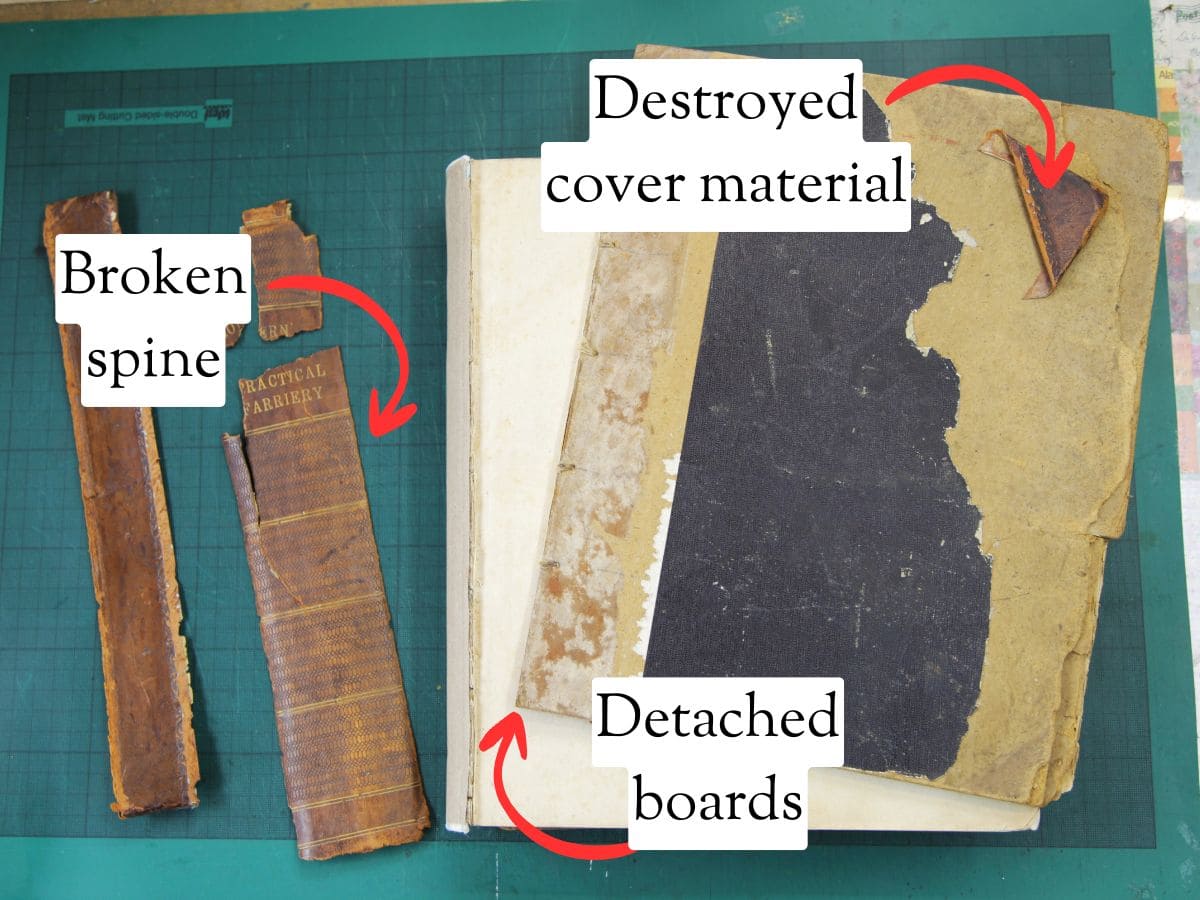
You’re finally getting around to having that treasured book restored. But where to begin? What does a bookbinder need to know to give you an accurate quote for a book repair project? How do you describe a books’ condition so we know what you’re referring to? Each binder may have further questions, especially concerning the value of the book if it’s an antique volume, but for most of us this simple 4 step assessment you can carry out at home will help us present you with an appropriate estimate.
Before we take a look at how to assess the different parts of the book, it’s important to note that time not material is the most expensive component. This is really true no matter how big (or small) the book is – for example, a small book with lots of paper repairs my end up costing more than a huge Victorian family Bible which only needs a board reattaching.
With that in mind, let’s work through your book together…
The most important thing to know about the spine is its structure. I’ll explain why its important in a moment, but for now it will help if you can find a hardback and a paperback. Open the paperback and look at the spine.
The cover on the spine of the paperback curves with the book as you open it, which is why those spines end up with cracked lines running down them. This type of structure is a ‘tightback’ and it was the only structure for books before about 1830 and was still used well in to the 20th Century.
Now open the hardback book and look down the spine. Not just the dust jacket (if there is one) but the actual spine cover will have separated from the spine of the pages inside it to create a tunnel called a hollow. This is the standard structure for modern hardbacks, and is so common you’ve probably never thought about it.
Here’s why it matters. Repairing a book frequently involves needing access to the back of the pages (the “textblock” as we call it) whether that’s for resewing some or all of the book, or adding material to the inside of the cover spine so it can be reattached. If that cover spine is fully stuck to the book it’s much harder to do, and to detach such a leather spine without causing further damage is time consuming. So make a note of the structural type of your book – ‘tightback’ or ‘hollowback’.
This is probably a good time to mention that I very rarely repair paperbacks, and everything about the ‘tight back’ structure above is really referring to those much older leather books – the bit with the paperback was just for illustration purposes. The cost of repairing a paperback is typically many times the value of the book, and so often not considered worth it by the owner. That said, I appreciate that some paperbacks can carry significant sentimental value, so if you really want one preserved and protected, take a look at my Boxes page and I’m sure we can find the right one for your book.
Cover
Do you want to keep the original cover, replicate it, or replace it?
Leather, cloth, or something else?
Any material missing?
Stains or fading?
The most fundamental question you need to answer is, “How much does this cover mean to me?” For some people, the original cover with all its imperfections is a record of their own history, and they rightly want that preserved as much as possible. For others, the cover is just the protective cover the publisher chose and can be discarded, either for something functional or more personalised to them. Have a think about how you feel about these options.
They say “never judge a book by its cover” but in this case, you’ll have to! I usually aim to return the cover as near as possible to its original look, or if that’s not possible, to something in keeping with its design and age. You can see an example of how I achieved that for this very dilapidated Victorian farriery manual at the blog post about this challenging repair. [coming soon]
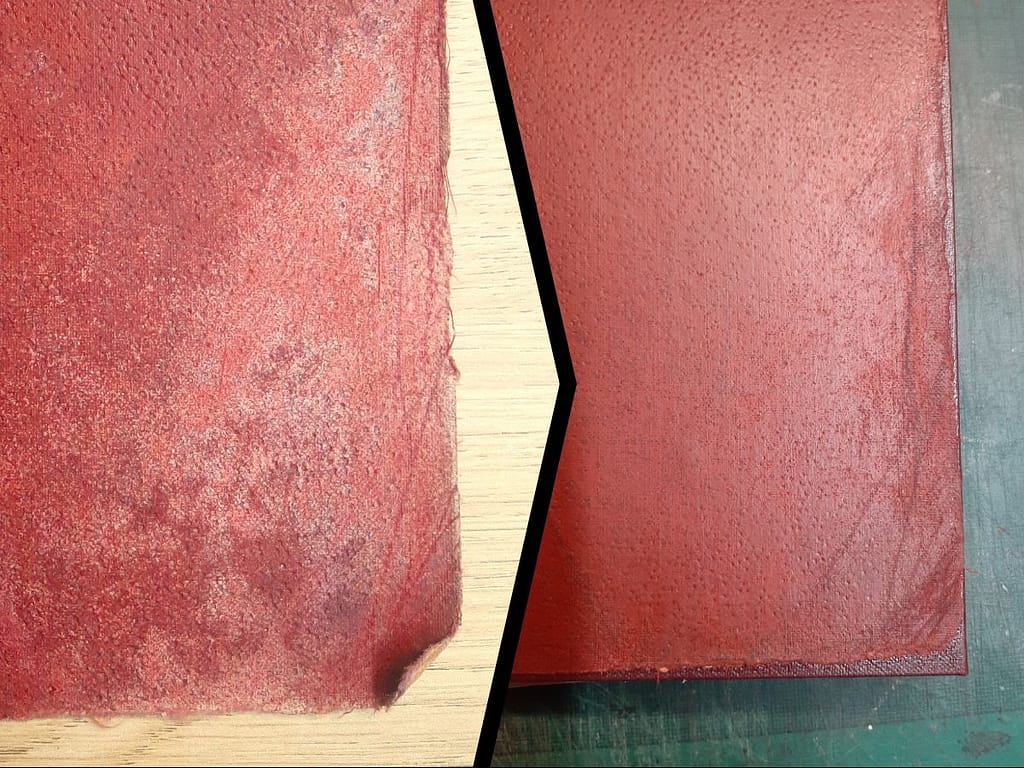
Sometimes it’s hard at first to tell the difference between leather and certain types of cloth which are embossed to imitate leather. This one is designed to imitate pigskin, which has very deep pores in clusters. The tell-tale sign for cloth is that it has stray strands of cloth peaking out wherever the cover is damaged. These are often quite small so you may need to look close, but you’ll be able to see the weave of the cloth unravelling. Obviously, leather doesn’t have a weave to unravel.
Old leather sometimes succumbs to Red Rot. Sounds horrific, but it’s not as dramatic as all that. If the leather on your book has gone a reddish-brown and is dry and powdery (wipe the area with a white piece of paper and it’ll leave a orangey mark), then I’ll need to treat it with a consolidant solution to prevent further deterioration. I can even redye it to blend in with the original colour.
What about stains or fading? Cloth stains more easily than leather, and will probably need to be replaced with a new cover if anything gets spilled on it. If the cover is simply grimy after years of use, a paste wash will help lift that and return some of its original colour to cloth, or add a lustre to leather, while fading can be treated with a colour touch up.
Pages
Approx. number of loose pages
Approx. number of pages with tears
Any paper loss?
Repairing the pages is often the most time consuming element of a book repair, so it’s best to know in some detail what condition the textblock is in.
If there are loose pages, they will either need to be ‘tipped in’ (glued in with a thin line of glue) or remade into sections. I do this by joining the separate pages together with strips of Japanese tissue and then resewn into the book, a process you can see the photos below.
Likewise, if there is ‘paper loss’ i.e. missing corners or edges so badly damaged that the page is now smaller than it should be, then those losses may need to be patched up with Japanese tissue to prevent any further loss. You can see more photos of these type of repairs in my blog post Can my book be repaired?
Endbands & Ribbons (+ video)
Ribbons – missing, frayed, or ‘stubs’?
Endbands – dirty, need replacing?
This is fairly straightforward to assess. For those books which typically have ribbons (Bibles, Missals, and Breviaries or other prayer books) the ribbons take a lot of strain, and I typically end up replacing them as a matter of course. Let me know how many you’d like, and if you have a preference for either double faced satin or woven (see pictures).
For endbands, these are also often replaced with new because they are typically the same machine-made bands widely available today, and thus is the most cost-effective solution. However, I will always try to reincorporate surviving headbands if they’re in a decent condition on a historical/antique book, or replace them if not. You can watch me recreate the missing hand-sewn silk endbands on a book from 1839 in the video below: